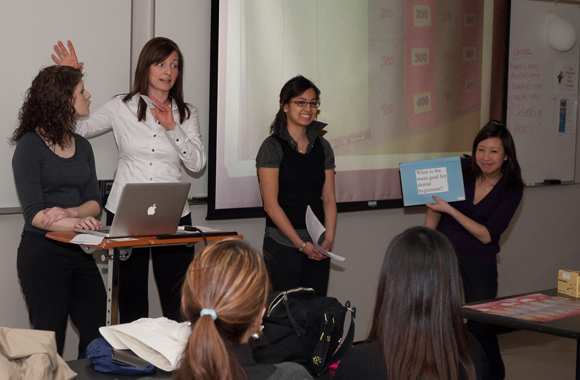
All four years of clinical and didactic instruction are taken at UBC Vancouver.
Students entering the Dental Hygiene Degree Program via the Entry-to-Practice Admission Option must take the following courses:
First Year (36 credits)
| DHYG 106 | Basics of Oral Microbiology | 3 credits |
| DHYG 108 | Oral Health Sciences I | 3 credits |
| DHYG 110 | Dental Hygiene Theory and Practice I | 6 credits |
| CHEM 121 | Structure and Bonding in Chemistry | 4 credits |
| BIOL 155 | Physiology & Intro to Anatomy | 6 credits |
| BIOL 180 | Thinking Like a Life Scientist | 2 credits |
| ENGL 110 | Approaches to Literature and Culture | 3 credits |
| WRDS 150 | Research and Writing in Humanities and Social Sciences | 3 credits |
| PSYC 101 | Introduction to Biological and Cognitive Psychology | 3 credits |
| PSYC 102 | Introduction to Developmental, Social, Personality, and Clinical Psychology | 3 credits |
Second Year (36 credits)
| DHYG 206 | Head & Neck Anatomy | 3 credits |
| DHYG 208 | Oral Health Sciences II | 12 credits |
| DHYG 210 | Dental Hygiene Theory & Practice II | 18 credits |
| STATISTICS 203 | Statistical Methods | 3 credits |
Third Year (36 credits)
| DHYG 310 | Dental Hygiene Theory & Practice III | 18 credits |
| DHYG 325 | Applied Pharmacology | 3 credits |
| DHYG 400B |  Policy Analysis and Change Policy Analysis and Change |
3 credits |
| DHYG 401 | Oral Epidemiology |
6 credits |
| DHYG 435 | Oral Medicine and Pathology |
3 credits |
| DHYG 461 | Critical Appraisal & Professional Writing in Quantitative Research |
3 credits |
Fourth Year (36 credits)
| DHYG 405 | Oral Microbiology and Immunology | 3 credits |
| DHYG 410 | Dental Hygiene Theory & Practice IV | 18 credits |
| DHYG 412 | Oral Health Care Trends and Topics |
6 credits |
| DHYG 462 | Critical Appraisal & Professional Writing in Qualitative Research |
3 credits |
| Electives2 | (3rd or 4th year level course(s) only) | 6 credits |
Courses with a “” denote courses that are offered jointly in an online, distance education format by the Faculty of Dentistry and the Centre for Teaching, Learning and Technology (CTLT). Courses with a “ ” denote classroom based courses.
Notes:
2Elective courses must be UBC courses (transfer credit is not permitted) and may be taken in areas of interest such as: health promotion, residential care, geriatrics, community health, adult education, health care ethics, inter-professional education, behavioural sciences, economics, etc. It is possible to choose suitable online elective courses or classroom-based courses.